by Kiddy123.com . on 22/12/2025 ...
Read our updated article for Starting a Taska/Daycare in Malaysia here.
Malaysia’s Education Act 1996 (Act 550) defines a kindergarten (tadika) as any place where preschool education is provided to 10 or more pupils from the ages of 4 to 6 years. The Education Act clearly states that kindergartens cannot operate unless they are registered under the act, i.e., registered with the Ministry of Education (MoE). However, the reality is that many private kindergartens in the country have yet to register – with rough estimates purportedly running into the thousands.
Reasons for not registering may include a reluctance to navigate the many layers in the application process. Also, instructions on what to do and what forms to use are not all available or easily searched on the portals of the various State Education Departments (Jabatan Pendidikan Negeri, in short, JPN) and District Education Offices (Pejabat Pendidikan Daerah, in short, PPD) — the two MoE agencies that process applications to register a private kindergarten.
Preschool education in Malaysia has expanded significantly over the past decade. According to national and international data, preschool enrolment for children aged 4+ to 5+ increased from 67% in 2009 to approximately 84% by 2020. While this reflects strong progress, Malaysia did not fully achieve its target of universal preschool enrolment by 2020. Challenges related to access, consistency, and quality remain, a reality faced by many developing nations. Nevertheless, the demand for early childhood care and education (ECCE) continues to grow steadily.
Under the Malaysia Education Blueprint, the private sector is expected to play a major role in expanding preschool capacity. The Blueprint projected that around 70% of new preschools would be privately operated, with approximately half of all preschool seats provided by private operators. This presents substantial opportunities for educators and entrepreneurs interested in establishing kindergartens, provided they meet regulatory and quality requirements.
To provide prospective kindergarten owners with a clearer picture of the registration process, Kiddy123 outlines the basic requirements and procedures for registering a private kindergarten in Malaysia. Applications are processed by the Ministry of Education (MoE) through the State Education Departments (Jabatan Pendidikan Negeri, JPN) and District Education Offices (Pejabat Pendidikan Daerah, PPD).
Applicants are strongly encouraged to refer to the Ministry of Education’s Bahagian Pendidikan Swasta (Private Education Division) portal, which consolidates updated guidelines, forms, and official references. The official Garis Panduan Tadika Swasta (GP Tadika Swasta) should be treated as the primary regulatory reference when setting up a private kindergarten.
To obtain the related forms for setting up a kindergarten, kindly contact your nearest JPN (here) or PPD (here).
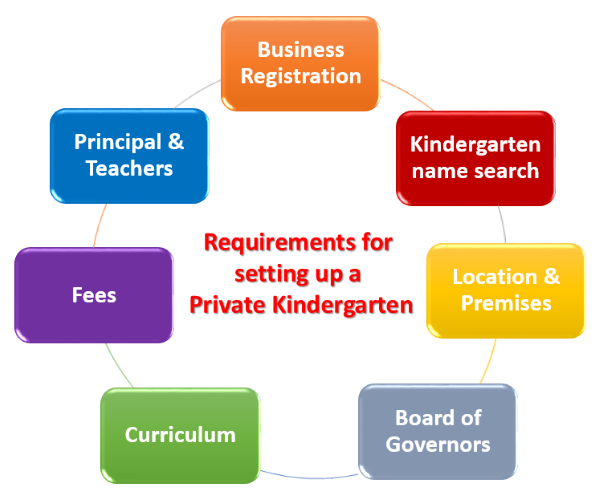
Let us first take a look at some of the basic requirements for setting up a private kindergarten in Malaysia.
Your business or company must be registered under the Business Registration Act 1956 or the Companies Act 2016. Unlike other private educational institutions, kindergartens may operate as sole proprietorships or partnerships. The minimum paid-up capital required for a kindergarten is RM10,000.
You are required to propose three suitable names for your kindergarten to the JPN or PPD. The naming guidelines are as follows:
Once a name is approved by the JPN or PPD, you must conduct a name search and reservation with the Companies Commission of Malaysia (SSM).
The location and premises of a kindergarten must comply strictly with local authority requirements and the GP Tadika Swasta. Premises must be safe and suitable, and should not be located in areas prone to flooding, landslides, erosion, or near industrial hazards and high-tension electrical infrastructure.
Kindergartens are not permitted to operate on standard residential lots unless specific conditions and approvals are granted by local authorities. In approved residential settings, consent letters must be obtained from neighbouring property owners within the stipulated radius as determined by the local council. All approvals are subject to local authority discretion.
If a kindergarten operates in a commercial building, it must be located on the ground floor or first floor. In stratified buildings such as flats, condominiums, or serviced apartments, the kindergarten must be located on the ground floor, or on the first floor if the ground floor is designated as a car park. Adequate indoor activity or play areas must be provided.
With regard to operating a kindergarten (tadika) and childcare centre (taska) within the same premises, this is allowed only if all regulatory conditions are fully met:
Failure to comply with these conditions may result in revocation of registration.
If you do opt to go with a franchise programme, such as Eduwis Preschool Franchise, you will receive their expert guidance in terms of location selection. Eduwis preschools operate in both residential areas and corner lots. As a franchisor, Eduwis provides consultation in strategic and suitable premise selection. This is key as the location and functionality of the space in the premise are some of the most important factors in setting up a successful kindergarten.
Every kindergarten must establish a Board of Governors (BoG) consisting of a minimum of three members, all of whom must be at least 18 years old. The Chairman of the Board must be a Malaysian citizen. The principal or headmaster serves as the Secretary to the Board but cannot be appointed as a Board member.
All principals and teachers employed by a kindergarten must be Malaysian citizens.
Teachers must:
Principals must:
All kindergartens are required to implement the National Preschool Standard Curriculum (Kurikulum Standard Prasekolah Kebangsaan, KSPK) until its replacement takes effect.
Beginning in 2026, all kindergartens will transition to the Kurikulum Prasekolah 2026 (KP 2026), which replaces KSPK 2017. KP 2026 is designed to provide a holistic foundation for young learners and is structured around six key learning areas:
Key enhancements under KP 2026 include increased play-based learning time, scheduled shared reading sessions, stronger emphasis on values and character development, and greater focus on independence and hands-on learning.
All kindergartens must ensure that their teaching syllabus and daily programmes are aligned with KSPK or KP 2026, depending on the applicable implementation period.
On the other hand, franchising is a great option too. You may select a franchise programme (as an additional programme) that is aligned with the KP 2026 curriculum, such as Eduwis Preschool Franchise.
Registration fees, term fees, payments for meals and kindergarten uniforms, and other fees charged will require approval from JPN/PPD. Fees paid must commensurate with the facilities and services provided and applications must be made for any fee increase. Fee increase is only allowed once in 3 years and must not be more than 30%.
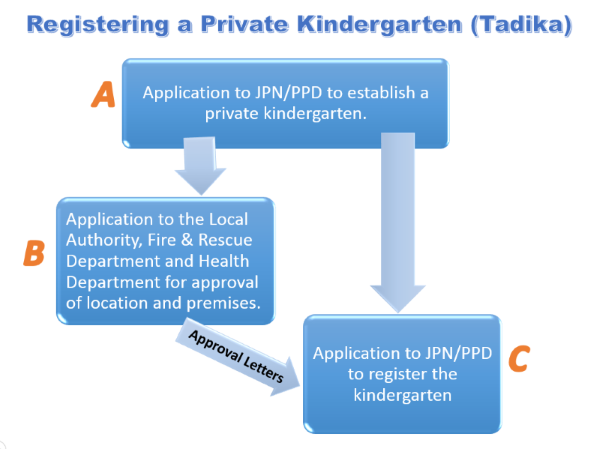
Before a private kindergarten can receive its certificate of registration from the MoE, there are three major stages (which may overlap) where applications have to be submitted to the government departments involved:
A)Application to JPN/PPD to establish a private kindergarten
B)Application to the local authority, Fire & Rescue Department and Health Department for approval of the location and premises
C) Application to JPN/PPD to register the kindergarten
The application for the establishment (penubuhan) of a kindergarten is the initial stage where the JPN/PPD checks your proposed set-up – i.e., your education programmes, financial standing, management, manpower, and facilities. The application is made using Borang BPS1, Borang 5F, and Senarai Semak Borang Permohonan and is submitted to either:
If you are thinking which option is faster, it usually depends on how busy the officer processing such applications is – there is usually only one officer doing this at the JPNs and PPDs. For example, if you are in districts such as Petaling Utama and Petaling Perdana in Selangor, where relatively more applications are received by the PPDs, you may wish to submit your application to JPN Selangor. Once your kindergarten has been approved and your certificate of registration received, you can still make a request for your file to be transferred to the PPD concerned if you wish.
When submitting Borang BPS1 and Borang 5F, besides the details pertaining to your business, Board members, principal and teachers, you will also need to submit:
For the location plan and floor plan, check how many copies the officer requires. The JPN in Kuala Lumpur needs 8 copies, while others need only sufficient copies for themselves, the local authority, Fire & Rescue Department, and Health Department. Note that your working paper is supposed to look impressive. JPN Pulau Pinang even provided a sample on their portal of how the cover page should look.
If all the documents are in order and your application is accepted, the officer is supposed to make a site visit to your proposed kindergarten (although not all do so).
After your application is received by the JPN/PPD, they will provide you with letters addressed to the Local Authority, Fire & Rescue Department, and Health Department requesting them to look into the other aspects of your kindergarten under their jurisdiction. You will also have to do a name search and booking at CCM for the kindergarten name that has been accepted by JPN/PPD. It would speed up things if you deliver these letters directly to the 3 departments. Note that it is your responsibility to obtain their endorsement of your kindergarten. Their approval letters are required by the JPN/PPD before your kindergarten can be registered.
Once the JPN/PPD is satisfied with the information and documents you have provided in (A) and with your location and premises, JPN/PPD will provide you with Borang B Kaedah 5 (T) and its attachments to apply for the registration of the kindergarten, while awaiting the approval letters from the local authority, Fire & Rescue Department, and Health Department.
You will have to submit Borang B Kaedah 5 (T) together with a receipt for RM5.00 (payment for processing fee and certificate of registration) and the following:
As can be seen from all the above, the setting up of a kindergarten is not an easy task. One needs knowledge of the business, a safe location, the right premises, and suitable and qualified people as board members, principals, teachers, and workers to provide the best environment for the pupils to be taught, to learn, to cultivate positive attitudes, to develop their character, and to grow strong and healthy. The many layers in the approval process are tedious and time-consuming but the regulations definitely help to ensure the well-being and safety of our little ones.
We very much welcome kindergarten owners who have gone through the registration process to share their experiences here. We have presented a general picture as a preliminary guide to new-comers. If you have any advice to give on the other details and processes, please do share with us here.

Disclaimer:
While every effort has been made to ensure that the information provided in this article is accurate, Kiddy123 Sdn Bhd shall not be liable for any special, incidental or consequential damages that may result from the usage of information obtained from this article.
No. 1 Malaysia Early Childhood Directory. We help parents to find preschools, enrichment programs, and more!